17 Years of Experience in Building and Installation Projects
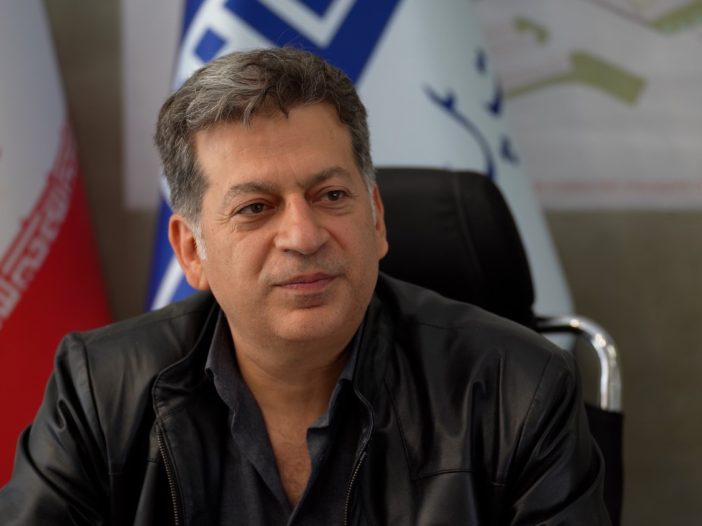
Mohammad Chamani, Chairman of the Board of Pol Sakhteman TakSazan Company, explained that the company began its operations in 2008 and, in the same year, obtained a Grade 5 certification in the fields of building construction and installations, laying the foundation for its implementation trajectory.
He stated that in 2010, the company formally expanded its activities with a strong focus on building and installation works, and over the course of more than a decade and a half, it has successfully executed more than thirty major projects.
According to Chamani, this accumulated experience gradually enabled the company to attain higher classifications, including Grade 2 in building construction, Grade 3 in installations, and Grade 5 in road and pavement works.
The chairman further discussed the challenges encountered along the way, noting that activity in the construction sector often involves a wide range of constraints and obstacles.
He explained that economic difficulties, fluctuations in currency value, social issues, and technological limitations were among the factors the company had to overcome through precise planning and effective management of human and technical resources.
Chamani emphasized that the company has consistently advanced its projects by prioritizing execution quality and practical, operation-driven solutions, deliberately distancing itself from excessive formalities and adopting a hands-on, workshop-oriented approach. He added that close cooperation among the management team, contractors, and project consultants has been key to the successful delivery of large-scale, multifunctional projects.
The Chairman of the Board also expressed hope that, by maintaining this professional approach, future projects will be completed successfully and that the company’s years of experience will serve as a model for implementing building and installation projects across the country.

“Saraye Banoo” Nears the Finish Line
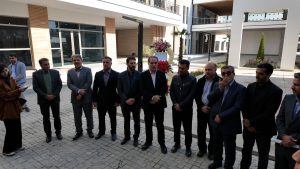
The Saraye Banoo project, now more than 90% complete, is approaching its final stage on a 17,000-square-meter site with 8,100 square meters of built area. Hassan Maghsoudi, the site supervisor, announced that the majority of the educational, cultural, and service spaces are ready for delivery, with only the entrance block and the amphitheater hall requiring final equipment installation.

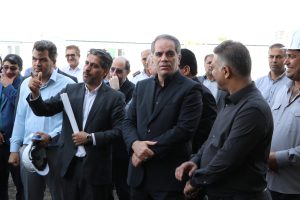
Hassan Maghsoudi, the site supervisor of the “Saraye Banoo” project, noted that construction has progressed at a favorable pace over the past two months on the 17,000-square-meter site, which includes approximately 8,100 square meters of built area. He stated that the overall physical progress of the project has now surpassed 90 percent. According to him, most educational, service, cultural, and administrative spaces have been completed and can be handed over once minor finishing tasks are finalized, although two main blocks have yet to reach their final stage.
He explained that Block “F,” serving as the project’s main entrance, along with the amphitheater hall, are the most critical sections still requiring completion, with the primary remaining tasks dependent on equipment procurement. Maghsoudi emphasized that the project has so far advanced largely through the contractor’s financial resources, which has helped maintain momentum within the current capacity. However, to accelerate progress and ensure completion by the scheduled deadline, he stressed that timely financial support from the client is essential.
According to Maghsoudi, many of the required components for the cinema hall and related sections are both costly and time-intensive to procure, making their finalization contingent upon new funding. He added that if the necessary financial resources are provided, the complex can be completed according to the timeline announced by the project’s CEO for year-end delivery—although some areas, such as the cinema hall, may be finalized later due to the specialized equipment they require.

Maghsoudi also explained that the recurring power outages initially caused disruptions in the construction process. However, after the company decided to deploy a generator, the workshop’s power supply stabilized, allowing the execution activities to continue without significant interruption.